BPC-157 is a synthetic pentadecapeptide discussed in the literature as a stable gastric peptide derivative and investigated in a range of preclinical models. For laboratory readers, the current evidence base is defined largely by animal and in vitro studies, while human claims remain unresolved and should not be inferred from preclinical findings [1][2].
Overview
BPC-157 is commonly identified in the literature as a gastric pentadecapeptide, often expanded as “body protection compound,” and has been examined in experimental contexts involving gastrointestinal tissue, tendon, ligament, muscle, bone, and vascular responses [1][2][3]. The published literature includes narrative and review-style syntheses, but the underlying evidence remains predominantly preclinical, with limited direct human data and substantial heterogeneity across models, endpoints, and study designs [1][2].
A recurring theme in the literature is that BPC-157 has been investigated as a pleiotropic experimental peptide rather than a single-target ligand [1][4]. Reported lines of inquiry include angiogenesis-related signaling, fibroblast migration, collagen-associated remodeling, and nitric-oxide-system interactions, but these remain mechanistic hypotheses derived from preclinical work rather than settled conclusions [2][4][5].
Structure and Properties
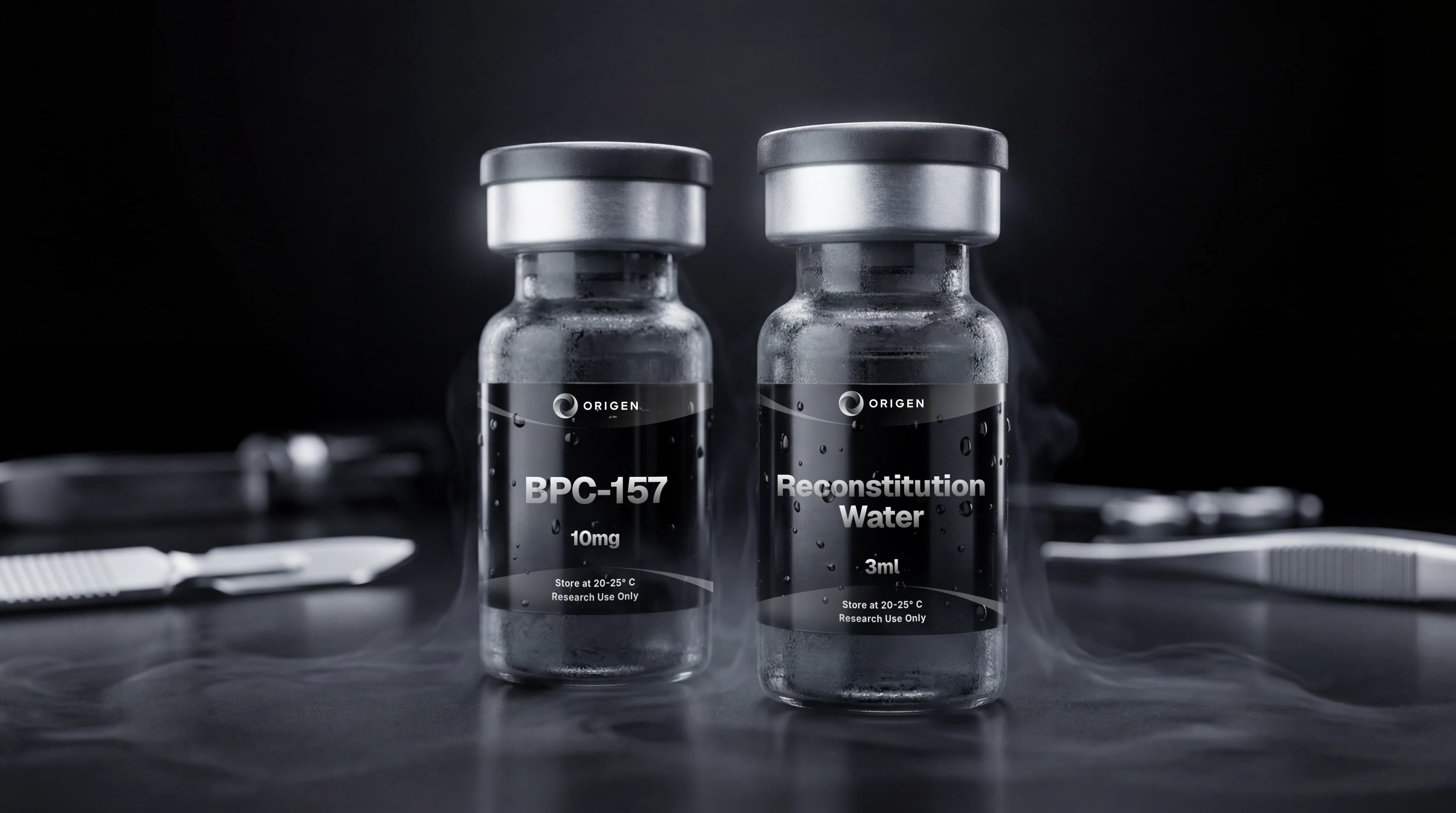
Within the Origen catalog, BPC-157 is supplied as a lyophilized powder with the sequence GEPPPGKPADDAGLV and a molecular weight of 1419.54. Those catalog identifiers align with the peptide’s standard shorthand designation in laboratory use and provide the most relevant practical reference points for handling and analytical documentation.
In the published literature, BPC-157 is frequently described as a stable gastric pentadecapeptide, and that reported stability is part of why it has attracted attention across multiple experimental systems [1][3]. However, literature descriptions of “stability” do not substitute for product-specific stability studies under a given laboratory’s own storage, solvent, light, temperature, and container conditions, and such variables should be validated analytically where the work requires it [1][3].
For solution work, peptide behavior can vary with solvent composition, pH, concentration, mixing method, and freeze-thaw history. Because the present catalog data do not provide a formal solubility specification or validated long-term storage claim for BPC-157, those figures should not be assumed; instead, laboratories should document reconstitution conditions, inspect for visible particulates, and confirm identity or integrity by appropriate analytical methods when needed.
Lyophilized peptides are generally handled to minimize repeated temperature fluctuation, prolonged ambient exposure, and unnecessary agitation during dissolution. In research settings where batch comparability matters, aliquoting after initial reconstitution and maintaining written chain-of-custody and storage records are standard good practice.
Mechanism of Action in Research
BPC-157 has been studied in the literature as a broad-response experimental peptide with proposed effects spanning angiogenic signaling, cytoprotection-related pathways, extracellular matrix remodeling, and nitric oxide system modulation [1][3][4][5]. The mechanistic literature is notable for breadth, but not for a single universally established receptor target, and many proposed pathways are inferred from downstream observations in cell or animal systems rather than direct target-binding confirmation [1][4].
One of the most frequently discussed mechanistic themes is angiogenesis. Review and synthesis papers describe reported interactions with vascular and endothelial signaling pathways, including VEGF-associated processes, as part of broader attempts to explain observed findings in soft-tissue and gastrointestinal models [2][3][4]. These reports are best read as pathway-level hypotheses under active discussion rather than definitive receptor pharmacology [2][4].
Another recurring line of investigation involves tendon-related cell behavior. In a tendon-focused experimental study, BPC-157 was reported to promote tendon outgrowth and to affect cell survival and migration in vitro, findings that have been repeatedly cited in later musculoskeletal discussions of the peptide’s possible biological activity [5]. Those observations are relevant to mechanistic research because they connect the peptide to fibroblast-associated and matrix-organizing processes, but they do not by themselves establish translational efficacy in humans [2][5].
The nitric oxide system is also a persistent theme in the literature. Early animal work and later synthesis papers describe BPC-157 as being investigated in relation to nitric oxide agonist- and antagonist-linked effects, and more recent discussions continue to frame NO-system modulation as one of the principal hypotheses for its pleiotropic activity profile [4][6]. Even so, the scope and direction of these effects vary across publications, which underscores the need for careful reading of model-specific conditions and endpoints [4][6].
Overall, the mechanistic record suggests that BPC-157 is being studied as a multi-pathway research compound rather than a narrowly characterized ligand. That distinction matters because broad preclinical signaling claims can outpace the level of direct mechanistic verification available in the primary literature [1][2][4].
Research Applications
The preclinical literature on BPC-157 spans several experimental domains, with musculoskeletal and gastrointestinal contexts appearing most often [1][2][3]. In tendon-focused work, investigators have used BPC-157 in cell migration, tendon outgrowth, and soft-tissue injury models to examine whether measurable changes occur in tissue organization and related cellular processes [2][5].
In gastrointestinal research, BPC-157 has been discussed in connection with mucosal and vascular responses, usually as part of broader questions around epithelial integrity, lesion models, and tissue response under stress conditions [1][3][4]. Because these studies often combine multiple endpoints and organism-level observations, they are useful for hypothesis generation but can be difficult to compare directly across laboratories [1][3].
BPC-157 has also been used in exploratory vascular and endothelial investigations, particularly where angiogenesis-related signaling or nitric oxide-associated phenomena are under study [4][6]. In that setting, the peptide is best positioned as a tool for preclinical pathway exploration rather than as a clinically resolved intervention, especially given the absence of a robust, standardized human evidence base [1][2].
A practical limitation across these application areas is that the literature contains a high proportion of preclinical studies and interpretive reviews relative to independent, well-controlled human trials [1][2]. For researchers evaluating BPC-157, this means experimental context, model choice, endpoint selection, and reproducibility should be weighed more heavily than generalized summaries.
Handling and Reconstitution Notes
Origen supplies BPC-157 as a lyophilized powder. In laboratory workflows, lyophilized peptide materials are typically allowed to equilibrate before opening, reconstituted with a validated laboratory solvent appropriate to the assay system, and mixed gently to reduce foaming or surface adsorption losses.
Because no catalog solubility figure or validated post-reconstitution shelf-life is provided here, laboratories should avoid assuming universal conditions. Instead, record solvent identity, concentration, preparation date, container type, and storage conditions for each preparation, and use aliquots where repeated access could affect analytical consistency.
Where study quality depends on concentration accuracy or peptide integrity, confirm the preparation by suitable analytical methods such as mass spectrometry or chromatographic testing under an internally validated workflow. Researchers should also track freeze-thaw exposure, visible clarity, and any deviations from standard operating procedures, since these can affect comparability between runs.
Related Compounds
Researchers exploring adjacent peptide categories may also review TB-500 (Thymosin Beta 4), which Origen lists with the sequence SDKPDMAEI EKFDKSKLKK TETQEKNPLP SKETIEQEKQ AGES and molecular weight 889.02, and GHK-Cu, listed with the sequence Gly-His-Lys and molecular weight 403.92. Origen also catalogs a combined BPC-157 + TB-500 presentation; where comparative or formulation work is contemplated, researchers should distinguish clearly between single-agent and blended materials in study design and analytical documentation.
Research Use Notice
Research Use Only. Not for human consumption. Not for use in the diagnosis, treatment, cure, or prevention of any disease. Laboratory research and analytical use only. Handle according to appropriate laboratory safety practices.
References
- Józwiak M, Bauer M, Kamysz W, Kleczkowska P, Pharmaceuticals (Basel, Switzerland), 2025. https://pubmed.ncbi.nlm.nih.gov/40005999/
- Gwyer D, Wragg NM, Wilson SL, Cell and tissue research, 2019. https://pubmed.ncbi.nlm.nih.gov/30915550/
- Seiwerth S, Milavic M, Vukojevic J, Gojkovic S, Krezic I, Vuletic LB, Frontiers in pharmacology, 2021. https://pubmed.ncbi.nlm.nih.gov/34267654/
- Seiwerth S, Rucman R, Turkovic B, Sever M, Klicek R, Radic B, Current pharmaceutical design, 2018. https://pubmed.ncbi.nlm.nih.gov/29998800/
- Chang CH, Tsai WC, Lin MS, Hsu YH, Pang JH, Journal of applied physiology (Bethesda, Md. : 1985), 2011. https://pubmed.ncbi.nlm.nih.gov/21030672/
- Grabarevic Z, Tisljar M, Artukovic B, Bratulic M, Dzaja P, Seiwerth S, Journal of physiology, Paris, 1997. https://pubmed.ncbi.nlm.nih.gov/9403788/